
NAA’s Rent Control Outlook: Fall 2025
By Ravi Ehrbeck-Malhotra and Ben Harrold
4-Minute Read
The Big Picture
After elevated activity at the beginning of the year, rent control proposals slowed during the summer as state legislatures went out of session. As new legislative sessions approach and affordability remains top-of-mind, however, the National Apartment Association (NAA) expects renewed interest in the policy in 2026. The sections that follow outline recent key developments from 2025 and where to watch in 2026.
NAA is tracking 131 active rent control bills across the country and about 40 additional failed bills. Many failed proposals are expected to be reintroduced in upcoming sessions, following historical trends. At the local level, NAA is tracking 9 rent control-related ordinances.
Unfortunately, policymakers continue to pursue these failed policies that would shrink housing supply amid a national shortage. Some jurisdictions are attempting to reverse course – Nebraska, for instance, passed a local preemption bill in April.
Recent Legislative Developments
Since our May update, new rent control activity has spanned state legislation, local ordinances and ballot initiatives.
Washington is the latest state to sign rent control in law. RCW 59.18.700 limits rent increases to 7% plus the change in the Consumer Price Index (CPI) or 10%, whichever is lower. The law also prohibits rent increases during the first year of a lease and mandates rental housing providers give tenants notice 90 days prior to a rent increase. The bill took effect on May 7, 2025.
Massachusetts: In September, the state Attorney General determined that a statewide rent control ballot question could legally appear on the November 2026 ballot. The measure would limit annual rent increases to the change in CPI or 5%, whichever lower, and would apply to most residential rental units with some exceptions. Proponents must now gather and file sufficient signatures by December 3. Massachusetts banned rent control via ballot measure in 1994 after the public saw its harmful impacts on supply and property values, so if successful, the measure would shift the landscape dramatically.
At the local level, several key actions occurred:
- Passaic, N.J. amended its rent stabilization ordinance in September, capping annual rent increases at 3% - down from 6% - and eliminating vacancy decontrol for buildings constructed before 1996. The updated ordinance is in effect.
- Salinas, Calif.’s city council repealed its rent stabilization ordinance in April, but a voter referendum halted the repeal. The council will now put the measure before the voters on the November 2026 ballot. Santa Barbara, Calif.’s city council rejected a rent stabilization ordinance that called for allowable rent increases of 60% of the CPI, but directed staff to study the issue and report back by the end of 2025. Both Salinas and Santa Barbara are areas to watch.
- In Wilmington, Del., Ordinance 25-016 - capping rent increases to 5% per year or the 12-month average of the CPI, whichever higher - failed in June. A similar proposal in Rockville, Md. also did not advance.
Risk Analysis
Rent controlled states
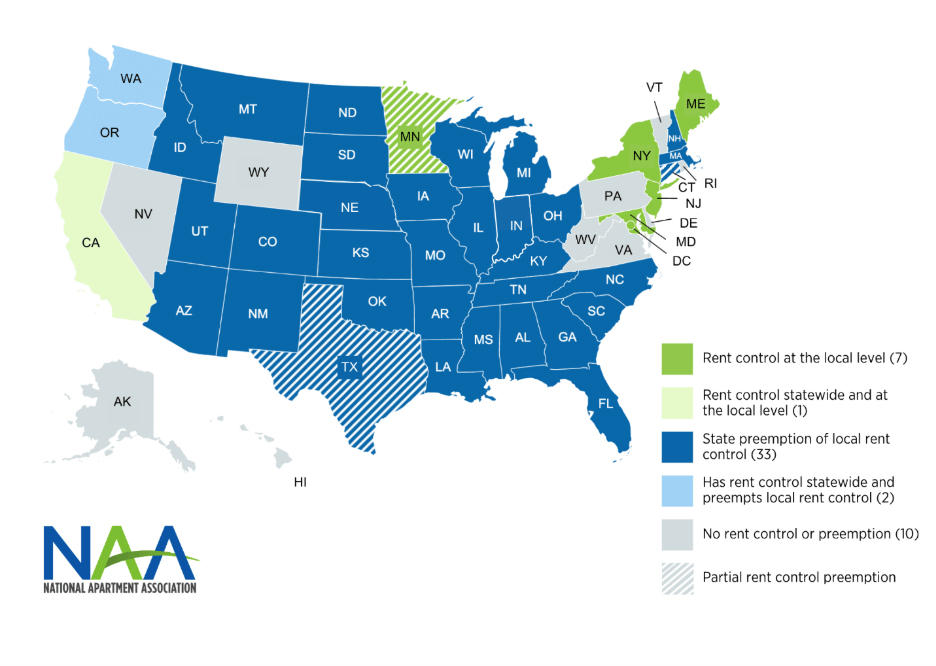
As of October 2025, 3 states – Oregon, Washington and California – have statewide rent control, in addition to Washington, DC. Oregon and Washington preempt stricter local policies and, given how recently it was adopted in both states, major changes are unlikely. California allows local jurisdictions to set more stringent policies. As in Salinas and Santa Barbara, city councils in California are often changing how rent can be set.
Local rent control
Five states – Maine, Maryland, Minnesota, New Jersey and New York – have rent control at the local level but no statewide policy or preemption. Local lawmakers in these states continue to pursue expansions. Notably, Zohran Mamdani, the Democratic nominee and leading candidate for New York City Mayor, has pledged to freeze the rent for every rent-stabilized resident in the city. This would, if enacted, apply to nearly 1 million rent-stabilized units. NAA is monitoring developments within these states closely.
Ten other states neither preempt nor have rent control, meaning local ordinances remain possible. However, a state without an explicit rent control prohibition may still prevent local jurisdictions from adopting the policy based on other powers granted to the municipal governments through the constitution, state code or judicial precedent.
The remaining 32 states have no statewide rent control and prohibit localities from enacting the policy, recognizing the harm done to housing markets. To enact local rent control, such states would generally have to revoke their preemption. Relevant bills or other high-profile efforts have been most active in Colorado, Connecticut, Illinois, Massachusetts, Michigan and New Mexico in recent years.
NAA Outlook
Rent control is based on the misconception that regulating rents improves affordability. Decades of empirical research show it does more harm than good, worsening supply, affordability, mobility, equity and overall economic health.
NAA continues its federal advocacy and support of its affiliate partners’ efforts to oppose rent control in all its forms, including through initiatives like NAA’s Housing Affordability Program (HAP) and the Housing Solutions Coalition (HSC). We urge lawmakers at all levels of government to focus instead on the supply crisis and tackle the barriers to developing new, affordable rental housing. To learn more, contact publicpolicy@naahq.org.